
At a glance, most smartphones look powerful enough to handle games. Large displays, fast processors, plenty of memory. Yet in real-world use, some phones stay smooth for hours while others stutter, overheat, or drain the battery quickly. That difference is not just marketing. It comes down to a few very real design choices.
Here is what actually separates a good gaming phone from an average one.
Processor Power Is About More Than Raw Speed
The processor, or chipset, is the single biggest factor in gaming performance, but raw speed numbers do not tell the full story.
Modern games rely heavily on the GPU, the graphics processor built into the chip. Two phones can feel equally fast for everyday tasks but perform very differently in games because one has a stronger GPU.
Phones that are better for gaming usually have:
- More powerful graphics hardware
- Better sustained performance under load
- Support for higher frame rates and advanced visual effects
Mid-range processors can run games well at first, but often struggle to maintain that performance over longer sessions. This leads to frame drops, stuttering, or automatic reductions in graphics quality.
Gaming pushes a phone much harder than most apps ever will.
Cooling Is a Big Deal
Heat is one of the biggest limits to gaming performance.
When a phone gets too hot, it slows itself down to protect the hardware. This is known as thermal throttling. You might start a game running smoothly, only to notice performance dropping after ten or fifteen minutes.
Phones designed with gaming in mind usually include:
- Larger internal heat spreaders
- Vapour chamber cooling instead of basic copper plates
- Internal layouts designed to move heat away from the processor
Phones without proper cooling can score well in short benchmarks but struggle during real gameplay. Sustained performance matters far more than peak performance.
The Display Affects How Games Feel
The screen plays a bigger role than many people realise.
For gaming, important display features include:
- High refresh rates, such as 120 Hz, for smoother motion
- Fast touch sampling for more responsive controls
- Stable brightness so the screen remains readable during long sessions
A phone with a powerful processor but a basic 60 Hz display can feel less responsive than a phone with slightly weaker hardware but a better screen.
Fast-paced and competitive games benefit the most from higher refresh rates and responsive touch input.
Battery Size and Power Management
Games consume a lot of power. High frame rates, constant graphics processing, and network activity all take their toll.
A large battery helps, but power management matters just as much. Some phones reduce performance aggressively to save battery life, even while gaming.
Better gaming phones strike a balance between:
- Battery capacity
- Efficient power delivery
- The ability to sustain performance without overheating
This is why some phones feel fine for short gaming sessions but struggle during longer play.
Software Optimisation Makes a Real Difference
Hardware sets the limits, but software decides how close a phone gets to those limits.
Well-optimised phones:
- Prioritise games when they are running
- Limit background activity automatically
- Offer performance modes that raise limits without excessive throttling
Poor optimisation can hold back even powerful hardware. This is also why two phones with the same processor can deliver very different gaming experiences.
Touch Response and Input Latency
Touch performance is often overlooked, but it matters more than most people expect.
Gaming-focused phones tend to offer:
- Higher touch sampling rates
- More consistent input at high frame rates
- Lower overall input latency
For casual games, this may not be noticeable. For shooters, racing games, or rhythm games, it makes a clear difference.
Why Gaming Phones Often Look Different
Gaming phones sometimes have unusual designs for practical reasons.
Thicker bodies, side-mounted charging ports, and unconventional camera layouts often exist to improve:
- Cooling
- Weight balance in landscape orientation
- Comfort while charging and playing at the same time
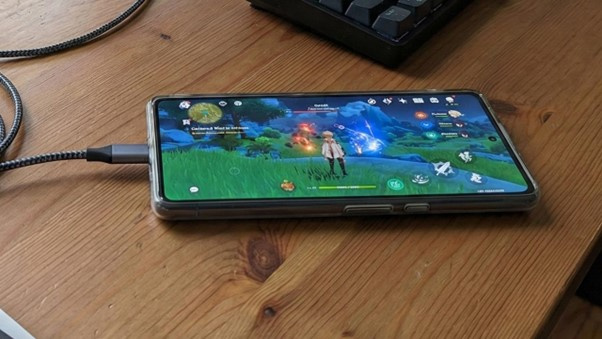
These choices prioritise function over appearance.
What This Means for Most People
If you only play games occasionally, almost any modern smartphone will do the job.
If you play regularly, play demanding titles, or care about smooth performance over long sessions, the differences become obvious very quickly. Phones designed with gaming in mind stay cooler, maintain performance longer, and feel more responsive when it counts.
That is why some phones feel effortless for gaming, while others feel like they are constantly holding themselves back.